Written by Business Moving Group — Southern California’s Commercial Moving Experts.
The Southern California commercial real estate market is in flux. With the rise of hybrid work models, Facility Managers in Irvine, Downtown Los Angeles, and San Diego face a critical decision point: Do we renew and optimize our current footprint, or do we relocate to a facility that better suits our modern needs?
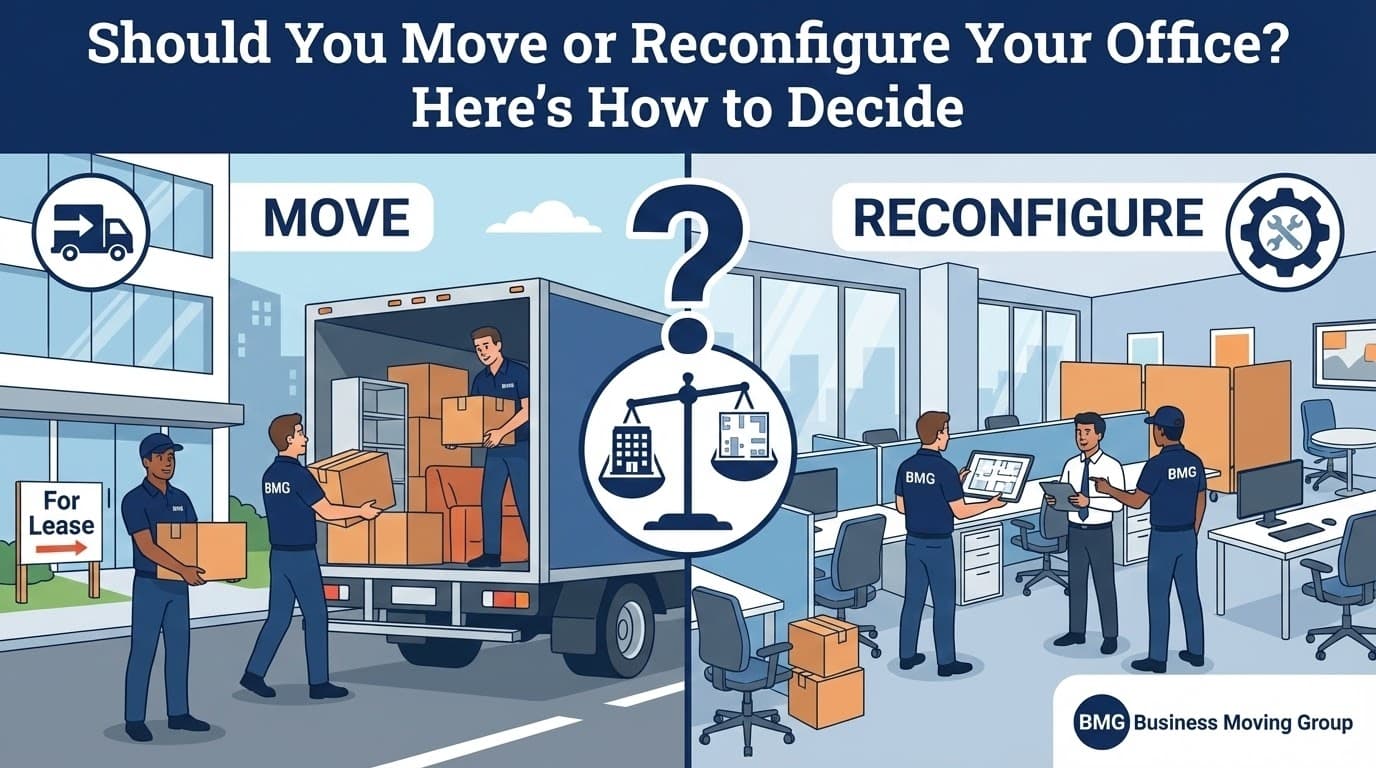
This is not just a question of rent per square foot. It is a question of operational efficiency, capital expenditure (CapEx), and employee productivity. At Business Moving Group, we handle both complex relocations and internal reconfigurations. We understand the logistics required for both, and we know that the "right" choice depends entirely on your specific growth trajectory and infrastructure needs.
Option A: Office Reconfiguration (Optimization)
Reconfiguration is the strategic modification of your existing space to align with current workflows. This often involves dismantling "high-wall" private cubicles to create open collaborative zones or retrofitting conference rooms with new tech integration.
The Logistics of Staying Put:
Reconfiguration is often perceived as "easier," but it requires surgical precision because you are performing construction in an active work environment.
- Electrical & Data: Moving a cubicle isn't just about furniture. It involves disconnecting electrical whips from floor monuments and rerouting data cables. This requires licensed installers to maintain code compliance.
- Space Planning: Can your existing Herman Miller or Steelcase systems be adapted? We often re-fabric and re-configure existing panels to save costs on new furniture purchases.
- Building Protection: Even for internal moves, we use Masonite floor protection to prevent damage to carpets and tiles during the shuffle.
When to Reconfigure
You have favorable lease terms but an outdated layout.
Your headcount is stable, but your workflow has become hybrid.
You want to minimize downtime (we can execute reconfigurations over a weekend).
Learn about our Furniture Installation & Reconfiguration services.
Option B: Office Relocation (Strategy)
Sometimes, a space simply cannot be fixed. If your building infrastructure (HVAC, elevators, parking ratios) is stifling growth, or if the location no longer serves your talent pool, relocation is the necessary step.
The Logistics of Moving:
Relocation offers a clean slate but involves higher logistical complexity and upfront costs.
- Decommissioning: You must factor in the cost of restoring your old space to "broom-clean" condition to reclaim your security deposit.
- Asset Management: This is the time to purge. We help audit your assets to determine what moves, what is sold, and what is recycled.
- IT Cutover: Relocation requires a coordinated effort to ensure servers and internet circuits are live at the new site on Day One.
When to Relocate
Your current lease is expiring, and renewal rates are unfavorable.
You need to downsize significantly due to remote work (shedding square footage).
You require a new geographic location to access a different labor market or client base.
Comparative Analysis: Cost vs. Disruption
Making the right call involves weighing the immediate disruption against long-term gain.
Factor | Reconfiguration | Relocation |
|---|---|---|
| Upfront Cost | Low to Medium. Mostly labor and new components. | High. Moving costs, TIs, new cabling, decommissioning. |
| Disruption | Low. Can be done in phases or after-hours. | Moderate. Requires physical pack-move-unpack cycle. |
| Permitting | Minimal. Unless moving walls or changing occupancy. | High. Occupancy permits, COIs, signage, etc. |
| Flexibility | Limited. Constrained by existing building envelope. | High. Complete freedom to choose a new shell. |
The "Hybrid" Approach: Reconfigure & Decommission
A growing trend in Southern California is the "Downsize & Upgrade." Companies are moving to smaller, higher-quality spaces. This involves a mix of logistics:
- Decommissioning the large, old office (recycling old furniture).
- Moving only essential technology and files.
- Installing new, modern furniture in the smaller suite.
This approach reduces long-term OpEx (rent) while modernizing the employee experience.
The Pricing Model Matters
Whether you move or reconfigure, avoid hourly estimates. Variables like elevator breakdowns or finding extra parts can blow your budget. Business Moving Group operates on Project-Based Do-Not-Exceed Quotes for both services, ensuring your budget remains fixed.
Summary: Start with a Site Walkthrough
You don't have to make this decision alone. Business Moving Group offers site assessments to evaluate the feasibility of reconfiguration versus the logistics of a move. We audit your furniture, assess your electrical needs, and provide a clear path forward.